
Reading Time: 5 minutes
For seasoned automotive importers in developing markets, the supply chain landscape is shifting. With traditional sources in Japan, Europe, and the US becoming increasingly expensive and supply-constrained, China has emerged as the new source for used cars.
China is now the world’s largest automotive producer and exporter. This massive scale generates a deep pool of high-quality, low-mileage pre-owned vehicles that offer unbeatable value for your market.
However, sourcing from China presents a unique challenge: fragmentation. Unlike mature markets with centralized export hubs, Chinese inventory is scattered across thousands of physical dealerships and regional auction houses.
To succeed, you need a strategy that cuts through the noise. Here is your step-by-step guide to finding and verifying the right stock.
🌐 Phase 1: Understanding Sourcing Channels
Understanding where the pre-owned cars are is the first step to securing a profitable deal.
1. The Reality of “Direct” Sourcing
Many importers initially look for “Direct Dealers” or “Physical Markets” (like Beijing Huaxiang or Guangzhou Used Car markets). While these (physical) dealers hold the actual inventory, they are rarely equipped to handle international trade.
- The Barrier: Most local Chinese dealers lack export licenses, international logistics networks, and English-speaking staff.
- The Risk: Attempting to buy directly often forces you to work through local trading companies. These middlemen don’t hold stock themselves; they aggregate vehicles from various small vendors. This adds layers to the supply chain, making it harder to verify history and negotiate firm prices.
2. The Auction Myth
China has a sophisticated auction ecosystem (e.g., UCC, Chehaoduo), but these are primarily designed for the domestic market.
- The Catch: Major Chinese auction platforms usually require local business registration and banking credentials. They are not typically “plugged in” to international networks.
- The Implication: As a foreign buyer, you usually can’t log in and bid directly. You rely on agents to proxy-bid for you, which can lead to opacity in pricing.
3. The B2B Solution: Centralized Digital Hubs
To bypass the inefficiencies of middlemen and the inaccessibility of auctions, dedicated B2B export platforms have become the most efficient channel.
These platforms act as a bridge, aggregating inventory from reliable domestic channels and packaging it for global trade.
- Key Players in the Market:
- Guazi (Guazi.com): A giant in the 2C space, offering vast inventory and standardized services.
- Taoche (Taocheche.com): Known for “peace of mind” used cars, providing national procurement and quality control.
- China Vehicle Hub (Chinavehiclehub.com): Unlike consumer-facing sites, this is a pure B2B platform. It is built specifically for professional importers like you, offering a direct line to verified Chinese supply chains without the retail markup.
💡 Pro Tip: If you are a serious volume buyer, prioritize B2B platforms. They offer the “one-stop-shop” experience you need, handling everything from sourcing to export documentation.
🔍 Phase 2: The Remote Vetting Process
Trust, but verify. Since you can’t walk the lot in person, you must implement a rigorous remote verification protocol. Never rely solely on photos provided by the seller.
1. Demand a Third-Party Inspection
This is non-negotiable. A seller’s word is not enough.
- Use “Cha Boshi”
 This is the gold standard for third-party vehicle inspections in China. They provide detailed reports on the chassis, engine, and body structure. Their stamp of approval is your best defense against hidden accident damage, flood damage, or fire damage.
 - Cost vs. Value: Yes, a third-party inspection costs money. But it is insignificant compared to the cost of importing a lemon.
 This is the gold standard for third-party vehicle inspections in China. They provide detailed reports on the chassis, engine, and body structure. Their stamp of approval is your best defense against hidden accident damage, flood damage, or fire damage.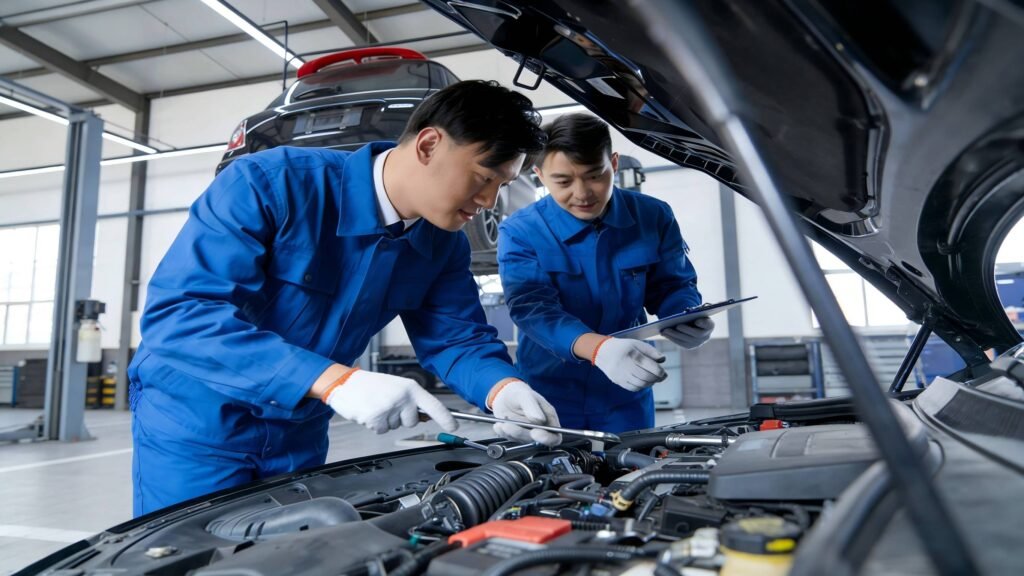
2. Pull the Data: “Che300” History Check
A car’s past predicts its future. Use data platforms like Che300  to access the vehicle’s history.
- What it shows: This platform aggregates data from insurance companies and 4S dealerships.
- Why it matters: It reveals the real mileage history and repair records. If a car was in a major accident six months ago, Che300 will likely know about it, even if the paint has been redone.
3. The “Live Video” Walkaround
Don’t just look at static photos. Request a Live Video Inspection.
- How it works: Ask your supplier or platform representative to go live with you via WhatsApp or Zoom.
- The Drill: Watch them start the engine, check the VIN plate, look under the hood, and inspect the undercarriage. Seeing the car in real-time, under your direction, adds a layer of transparency that photos cannot match.
📦 Phase 3: Logistics & Minimum Order Quantity (MOQ)
Understanding shipping logistics is crucial for your business plan.
- Container Capacity & MOQ
If your destination port only accepts container transport, plan your Minimum Order Quantity (MOQ) carefully.- Standard Capacity: A 40ft High Cube container is standard.
- Loading Guide: It fits 4 units of compact sedans (like the Toyota Corolla) or 3 units of SUVs (like the RAV4).
- Strategy: Calculate your MOQ based on container efficiency to maximize profit.
- Shipping Timeline:Plan your inventory flow with realistic timelines.
- Process Time: From payment received to vessel departure.
- Duration: Usually 2-3 weeks.
- Variables: This depends on the vehicle’s location and specific vessel schedules.
📝 Summary: Your Action Plan
- Choose the Right Channel: Skip the unverified trading companies. Use established B2B platforms (like ChinaVehicleHub) to access reliable inventory with export-ready logistics.
- Verify, Verify, Verify: Always request a Cha Boshi report and a Che300 history check. These documents are your due diligence.
- Plan: Know your container MOQ (4 compact sedans or 3 compact SUVs).
- See it Live: Whenever possible, conduct a Live Video Walkaround to confirm the car matches the report.
By mastering this sourcing and vetting process, you transform China from a mysterious, fragmented market into a reliable, high-margin supply source.
Ready to explore the inventory?
Check out the latest stock on ChinaVehicleHub.com and see how direct B2B sourcing can boost your bottom line.
#AutoImport #UsedCars #ChinaExports #AutomotiveBusiness #VehicleSourcing #EmergingMarkets #CarDealers #SupplyChain #ChinaVehicleHub