How Energy Storage Is "Subsidizing" EV Exports — A New Model for Emerging Markets
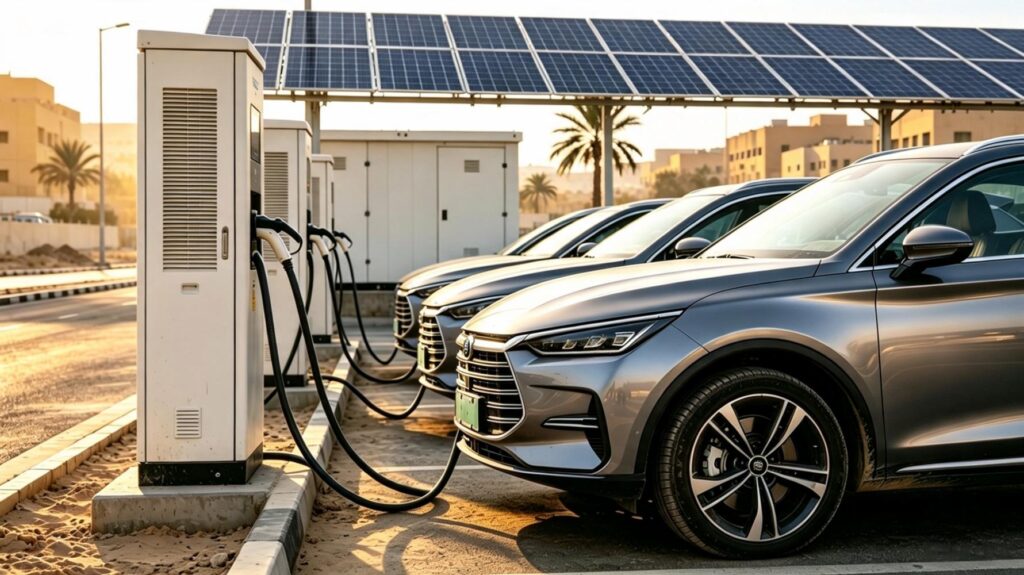
If you follow China’s automotive exports, you’ve probably noticed a shift: the conversation is no longer just about “how many cars we shipped.” It’s about “what else came with them.”
The headline numbers are still there — China exported over 6 million vehicles in 2025, and NEVs accounted for roughly 40%. But beneath those figures, a structural change is happening. The most profitable deals today aren’t pure vehicle sales. They’re energy infrastructure contracts that happen to include vehicles.
This isn’t a subsidy from Beijing. It’s a commercial model where energy storage systems (ESS) — solar-plus-storage microgrids, battery banks, swap stations — land in a target country first, and then make it cheaper, easier, and more logical to buy Chinese EVs.
I call this “storage-first, vehicle-second” export model. Here’s how it works, and why it matters for your market.
Why This Model Exists
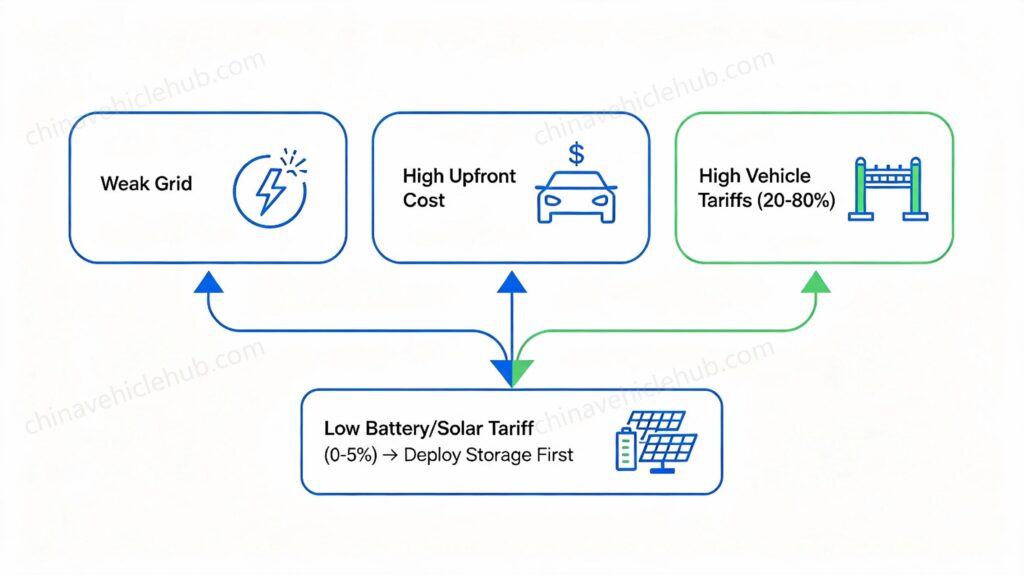
Three realities collide:
Many emerging markets have weak grids. You can’t sell EVs if there’s nowhere to charge them.
EVs are still expensive upfront. Even with falling battery costs, a $30,000–$50,000 car is out of reach for most fleet buyers without financing.
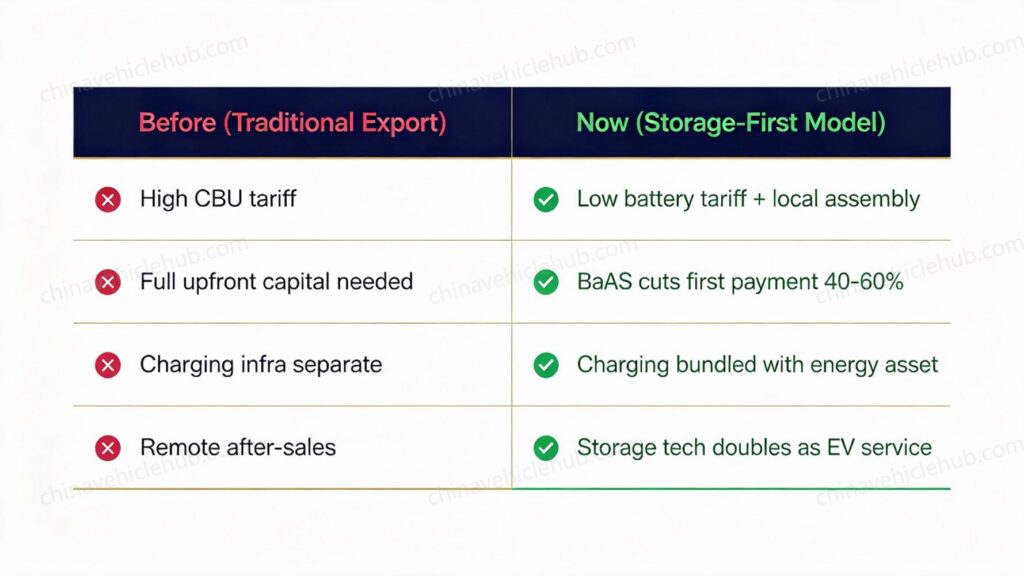
Energy storage has lower trade barriers than vehicles. Tariffs on lithium batteries and solar panels are often 0–5%, while CBU vehicle tariffs can hit 20–80%.
So Chinese players flipped the sequence: export the energy infrastructure first, use its margins to subsidize the vehicle entry later.
Five Models That Are Already Running
1. Solar-Storage-Charging as a Turnkey Package
Where it works: Africa, Southeast Asia, Middle East, Latin America — anywhere with unreliable grid power.
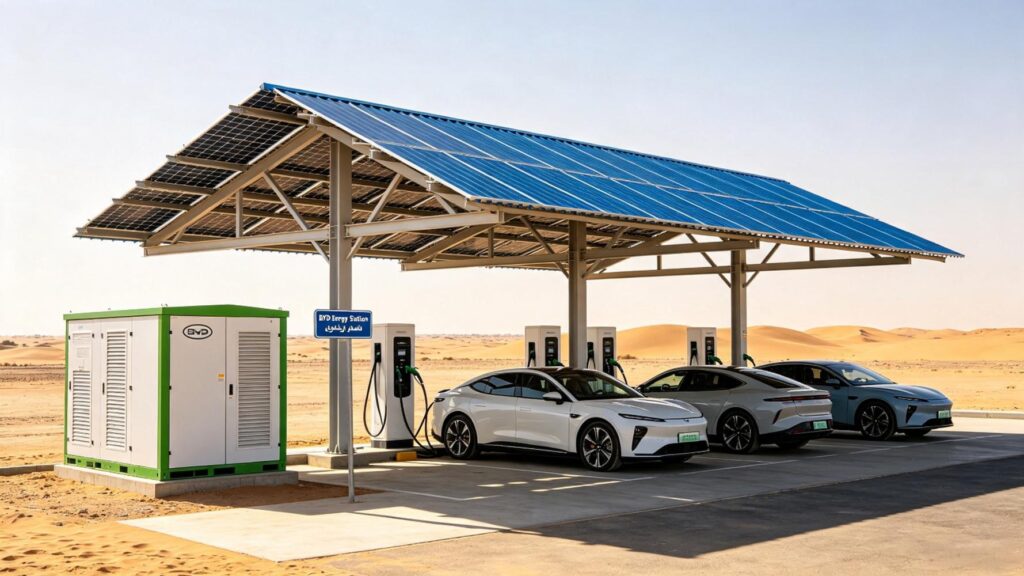
How it works: A Chinese company builds a solar PV array + battery storage + DC fast chargers as one integrated project. The customer buys the energy system; the chargers happen to be compatible with the same brand’s EVs.
Example: BYD in Saudi Arabia won a 12.5 GWh grid-scale storage contract. Alongside it, they deployed residential solar-storage-charging kits. Once a home or business has BYD solar + BYD battery, buying a BYD EV becomes the natural next step — charging cost drops 25% vs. building an independent setup.
Benefit for the target country: Grid stability + EV readiness in one investment. No need to wait for national utility upgrades.
2. Battery-as-a-Service (BaaS) + Swap Stations
Where it works: Commercial fleets — taxis, buses, trucks, last-mile delivery — where total cost of ownership (TCO) matters more than sticker price.
How it works: The battery is owned by a separate asset pool (“battery bank”), not the driver. The buyer purchases only the vehicle body (no battery), paying a monthly rental fee for the battery. Swap stations handle refueling in 3–5 minutes.
Real case: CATL × Octopus Energy (UK) launched heavy-truck battery swap stations with 24 batteries per station, capable of 192 swaps/day. The truck chassis alone costs ~$60,000 less than a full battery-included truck. At 100,000 km/year, per-km cost beats diesel by $0.06/km.
Benefit for the target country: Lowers fleet electrification CapEx by 30–40%. Batteries stay professionally managed, recycled, and cycled for grid services during idle hours.
3. V2G (Vehicle-to-Grid) as a Grid Service Contract
Where it works: Europe, Australia, parts of North America with mature electricity markets.
How it works: EVs become distributed energy resources. Bidirectional chargers allow the car to discharge back into the grid during peak demand. The grid operator pays the fleet owner for this flexibility.
Chinese players like BYD, JMC, and CATL now bid for grid-balancing tenders using a package of “bidirectional chargers + cloud dispatch platform + vehicles.” The grid contract includes a commitment to purchase a minimum number of V2G-capable EVs.
Benefit for the target country: Reduces grid upgrade costs. Utilities don’t need to build new peaker plants — they lease EV batteries instead.
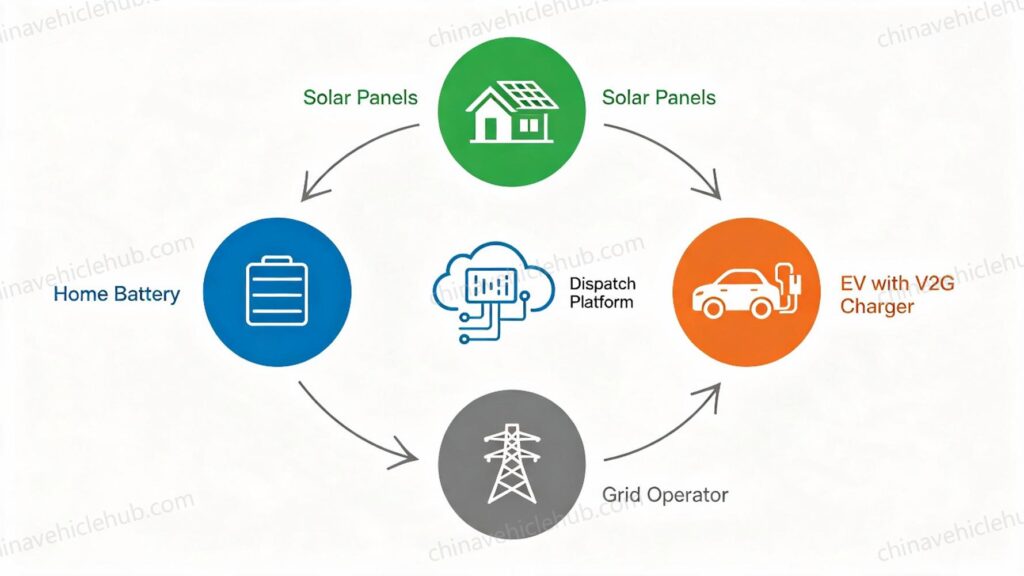
4. Large-Scale Storage Contracts That Unlock Vehicle Standards
Where it works: Anywhere a Chinese battery maker signs a multi-GWh storage deal.
How it works: When CATL signs a 5 GWh storage agreement with a European utility, the contract often includes provisions for cell standardization, BMS protocols, and local certification pathways. Those same standards then apply to EV batteries entering the same market — cutting homologation time and cost for Chinese-brand EVs.
Example: CATL’s €4.1 billion joint venture with Stellantis in Spain. The factory produces LFP cells for both stationary storage and Stellantis EVs. Once the cell standard is embedded in Spanish energy infrastructure, any Chinese OEM using CATL cells gets a faster path to compliance.
Benefit for the target country: Attracts battery gigafactory investment. Creates local jobs in cell assembly, recycling, and maintenance.
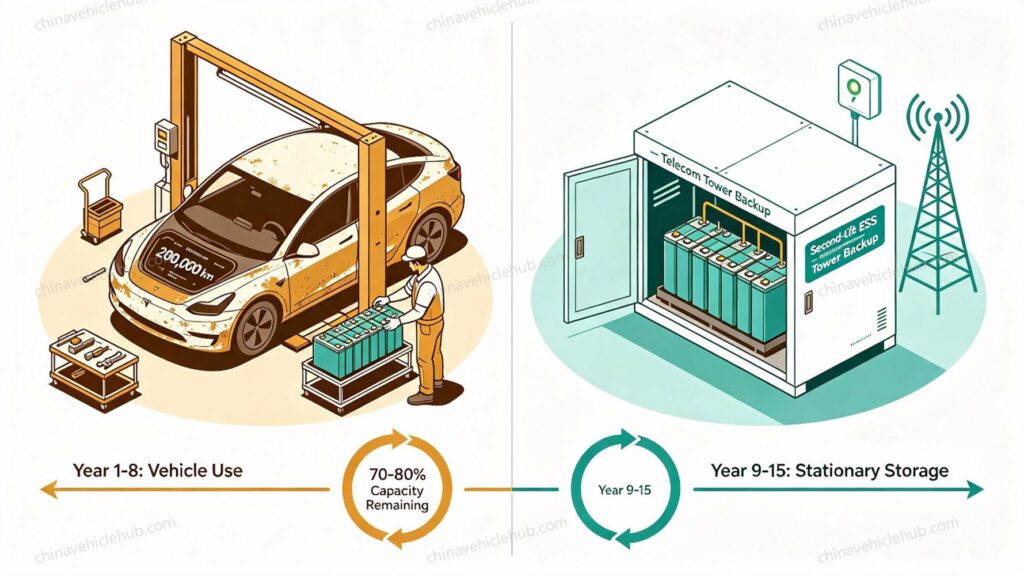
5. Second-Life Battery Integration
Where it works: Markets where retired EV batteries can be repurposed for commercial/industrial storage.
How it works: After 8–10 years in a vehicle, a lithium iron phosphate (LFP) battery still retains 70–80% capacity. Instead of recycling immediately, these batteries are cascaded into stationary storage units for factories, warehouses, or telecom towers.
The revenue from second-life storage projects funds extended warranties on new EV batteries. This lowers the warranty reserve cost for exporters, allowing them to offer competitive pricing.
Benefit for the target country: Circular economy without importing waste. Lower-cost storage for industrial users.
What This Means for Your Market
If you’re a policymaker, fleet operator, or energy developer considering Chinese EV adoption, here’s what the “storage-first” model changes:
Three Signals to Watch
Shipping lines now accept “battery-separated” bookings — batteries go in containers, bodies go on Ro-Ro vessels. Total freight cost drops ~19%, but liability boundaries create new negotiation points.
Overseas Chinese auto parts chains are reverse-sourcing — AutoZone-style stores in Europe and North America now buy Chinese dismantled parts via Temu B2B. The used-car aftermarket supply chain globalized before the new-car one did.
Letters of credit for used-vehicle exports now require OBD data access — Central Asian banks won’t release funds unless the vehicle’s onboard diagnostics show no outstanding domestic leases. Data sovereignty is becoming a trade condition.
The Bottom Line
The “storage-first, vehicle-second” model is not about Chinese companies being generous. It’s about embedding vehicles into an energy services contract — turning a one-time hardware sale into a recurring subscription for mobility, storage, and grid services.
For target countries, the math is simple: you get grid resilience, lower fleet electrification costs, and a circular battery economy — all wrapped around a vehicle that finally makes financial sense.